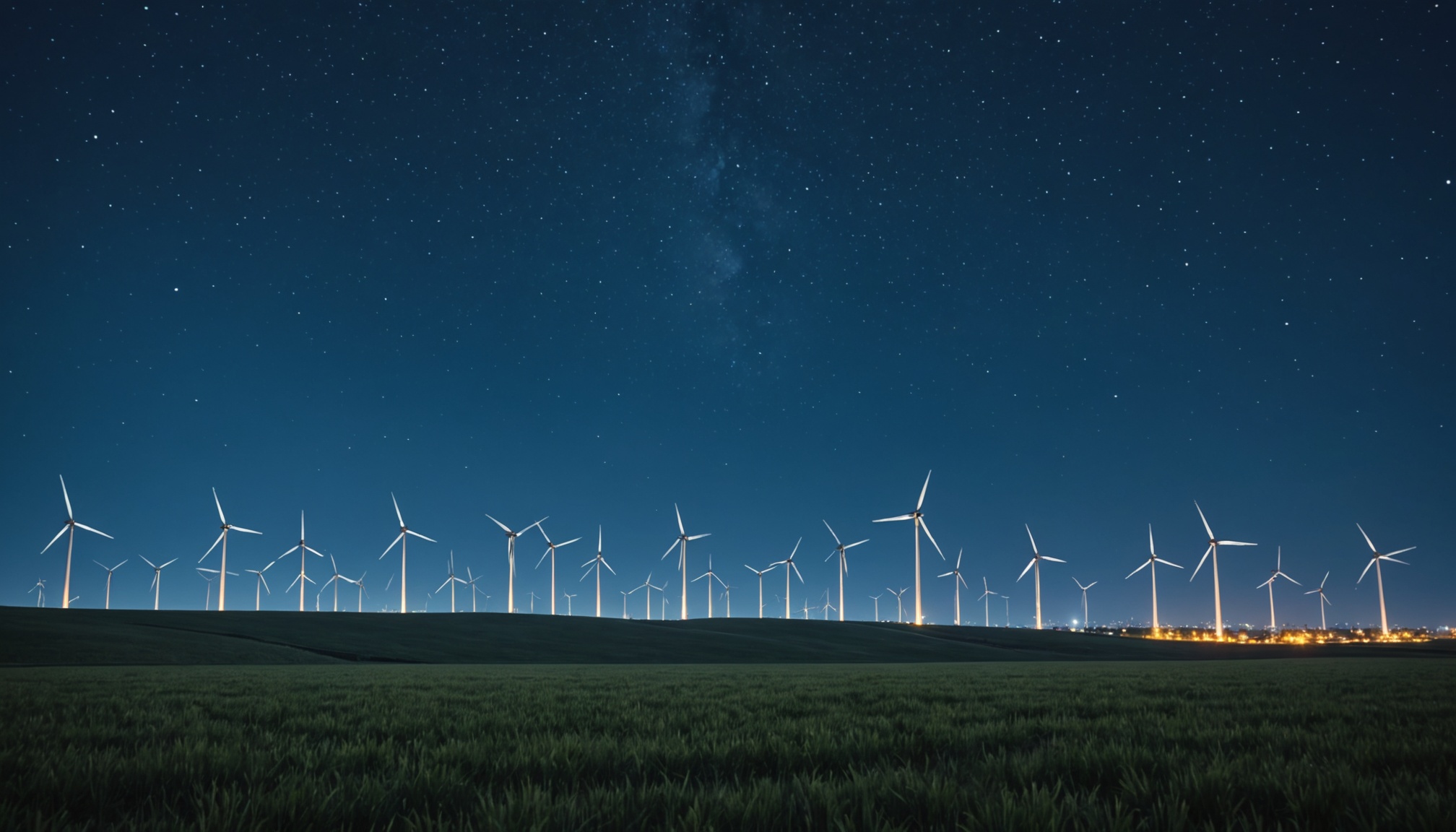
On the night of October 25, 2026, at 4:15 a.m. precisely, French wind turbines supplied the equivalent of 51.1% of the electricity consumption of mainland France. This figure, published by grid operator RTE, marks a new wind power record for the share of national demand covered by this energy source alone, at an hour when the French are asleep and consumption is at its lowest.
The result is impressive, but it deserves to be put into context so it isn't misread. Contrary to what one might think, this is not a record for raw power output: that record is still held by October 23, 2025, with 20,138 megawatts fed into the grid. The record set on October 25, 2026 concerns a different ratio, namely the share of consumption covered at a given moment, which depends as much on wind strength as on the level of electricity demand, which is very low at night.
A combination of circumstances rather than a technological breakthrough
Wind power was able to climb to such a level because of two factors combined. On one hand, a low-pressure system well positioned over Western Europe produced a sustained, steady wind across the country's onshore and offshore farms for several hours. On the other hand, nighttime consumption, excluding peak electric heating, drops to levels far below those seen during the day or evening. The same volume of wind output, measured against lower demand, automatically pushes up the coverage percentage.
France's wind fleet, for its part, has not exploded in a matter of weeks. As of June 30, 2026, its total installed capacity stood at 26.7 GW, including 24.4 GW onshore and 2.3 GW offshore. New connections in the first half of 2026 added only 0.8 GW of fresh capacity, a sign that growth has slowed markedly compared with previous years, notably because of project approval delays and administrative appeals.
A trend that extends beyond France's borders
This French nighttime peak fits into a broader dynamic observed across the continent. In the first half of 2026, wind and solar power combined produced 398.8 terawatt-hours in Europe, a level never before reached for that time of year. The two energy sources are now advancing hand in hand: when one weakens at night or in winter, the other takes over during the day or in summer, a complementary effect that grid operators are watching closely to anticipate flexibility needs.
- October 25, 2026, 4:15 a.m.: 51.1% of French consumption covered by wind power, a record coverage rate according to RTE.
- October 23, 2025: absolute wind power output record, with 20,138 MW fed into the grid.
- June 30, 2026: French wind fleet at 26.7 GW installed (24.4 GW onshore, 2.3 GW offshore).
- First half of 2026: 398.8 TWh produced by wind and solar combined across Europe, a record.
For households, this kind of record is mostly symbolic: on its own, it changes nothing about the price paid on the electricity bill. But it does illustrate the trajectory of the national power mix, a subject on which everyone can already take action, for instance by regularly comparing electricity supplier offers or by looking into renewable energy storage, a link in the chain that is still underdeveloped but crucial for smoothing out these production peaks. Households equipped with solar panels, meanwhile, have every reason to properly maintain their installation to make the most of this seasonal complementarity with wind power.
The balance between wind power development and biodiversity preservation also remains a closely watched issue: several wind farms now apply nighttime blade curtailment to protect bats, proof that the growth of this energy source comes with ongoing technical adjustments. Upcoming reports from RTE will show whether this October record remains an isolated event or signals a lasting trend, as new offshore wind farms come online along the French coast.
Frequently Asked Questions
Does the October 25, 2026 record mean France has switched to 100% wind power?
No. The 51.1% figure corresponds to a specific moment, at night, when overall electricity consumption is at its lowest. Over the course of a full year, wind power's share of the French electricity mix remains far more modest, around 10 to 13% depending on the quarter.
Why are the wind power output record and the coverage rate record two different figures?
The first measures megawatts produced in absolute terms, regardless of consumption at that moment. The second measures the share this production represents relative to electricity demand at that precise moment, which varies greatly between day and night.
Does this record directly benefit households' electricity bills?
Not immediately or automatically: electricity prices depend on many factors, including wholesale markets and supplier contracts. However, a mix richer in renewables can, over time, help limit dependence on imported fossil fuels.
Sources
L'Énergeek,
Révolution Énergétique,
RTE – First Half 2026 Report.
This article was written with the help of artificial intelligence. Editorial policy