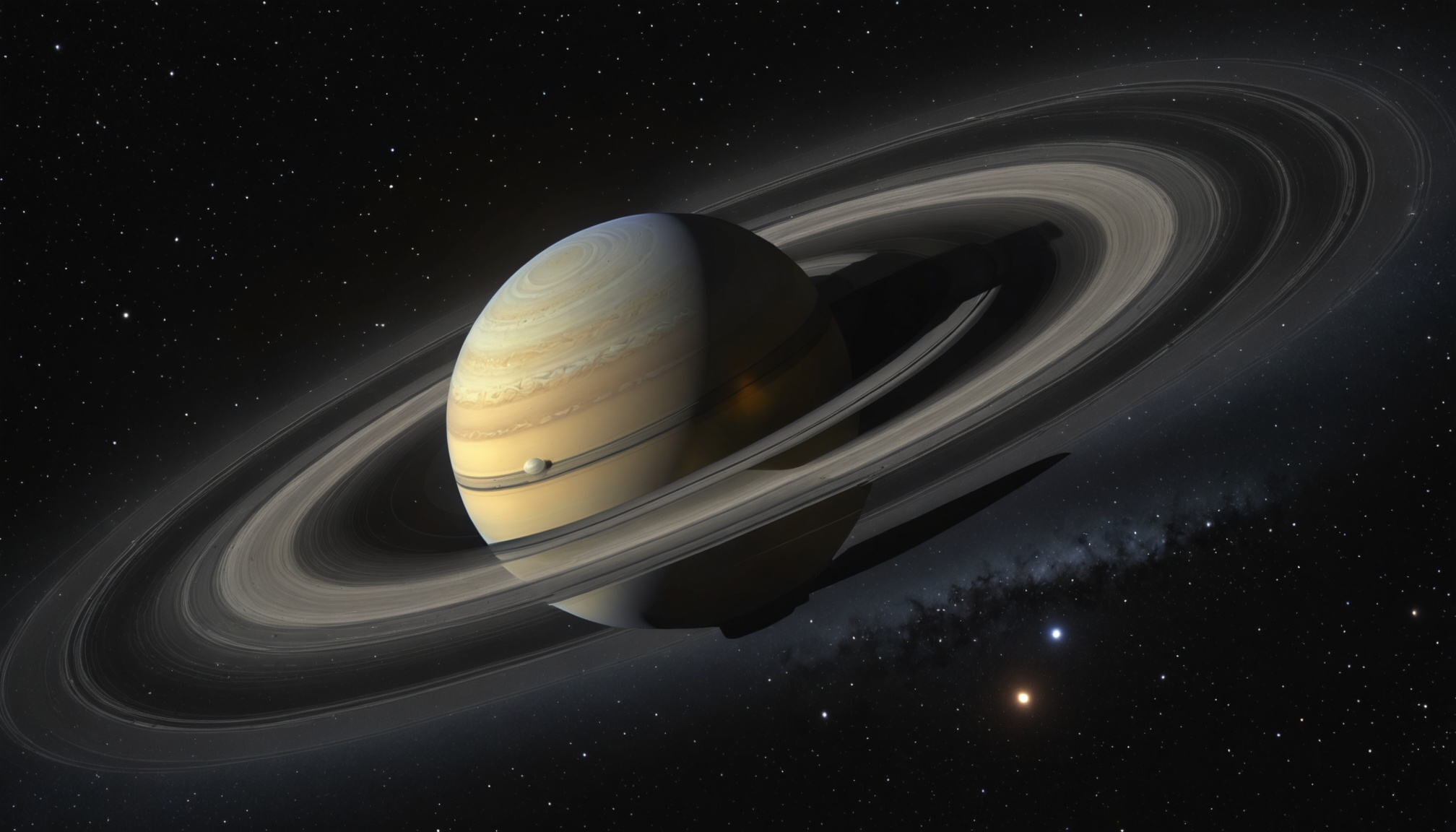
Every fall, amateur astronomers watch for one precise event: the moment when a giant planet lines up directly opposite the Sun from Earth. This year, Saturn's opposition took place on October 4, offering the best window of the year to observe the ringed planet with the naked eye or through a telescope.
What Is a Planetary Opposition?
An opposition occurs when Earth slides exactly between the Sun and a planet located farther out in its orbit. Saturn then reaches its minimum distance from Earth for the year, remains visible all night long, from sunset to sunrise, and reaches its peak brightness. On October 4, 2026, at 12:21 p.m. UTC, Saturn peaked at a magnitude of +0.33, making it easy to spot in the night sky, even without any equipment.
An Ideal Observation Window for Several Weeks
Unlike an eclipse, an opposition isn't a fleeting instant. The nights surrounding the exact date remain excellent for observing the planet, and the entire first half of October offers favorable conditions. Astronomers recommend focusing on culmination around 1 a.m., when Saturn is highest in the sky and atmospheric turbulence is at its lowest. With a simple 130 mm refractor, the Cassini Division — the thin dark gap that separates the two main rings — becomes visible; starting at 200 mm, you can also make out the planet's cloud bands and up to five of its moons.
Rings Still Barely Open After Their Apparent Disappearance
What makes this opposition special is that it comes just over a year after a rare phenomenon: the rings passing “edge-on,” which made them nearly invisible from Earth on March 23, 2025. This optical illusion, which recurs roughly every fifteen years, is explained by the rings' extreme thinness — only 10 to 100 meters, for a disk 360,000 kilometers wide. As of October 2026, the rings are therefore not yet widely open: the measured tilt is only 9.15 degrees. But that's precisely what makes this the best opportunity to watch them gradually reopen, month after month, before they reach their maximum tilt in the coming years. This interplay of angles is a reminder that exploring the sky keeps delivering surprises, as recently shown by the discovery of an unprecedented radio signal detected on an exoplanet.
How to Best Observe Saturn from France
- Choose a location away from city lights, with a clear southeastern horizon early in the evening.
- Let your equipment cool down to outdoor temperature before observing, to avoid internal turbulence.
- Favor moonless nights or those with a thin crescent, for better contrast.
- Spot Saturn with the naked eye thanks to its steady glow, unlike the twinkling of stars.
- Wait several minutes at the eyepiece: the eye needs time to pick out fine details like the Cassini Division.
This kind of observation is part of a long tradition of studying the sky, one that also has its own little-known chapters of history, like the handwritten annotations by Galileo found in an astronomy treatise. Modern instruments, meanwhile, keep pushing back the limits of what can be observed, as illustrated by the Euclid telescope's discovery of the oldest quasars ever observed.
For science enthusiasts and those curious about our planet alike, this astronomical event is a reminder that sometimes all it takes is looking up to get a glimpse of the sheer vastness of the solar system.
Frequently Asked Questions
Do You Need a Telescope to See Saturn During Its Opposition?
No, Saturn is visible to the naked eye as a steady, bright point of light. A pair of binoculars is already enough to make out its elongated shape caused by the rings, but you need a magnification of at least 50x to clearly distinguish the ring itself.
Why Do Saturn's Rings Look So Thin This Year?
Because Earth and Saturn have only just emerged from the March 2025 alignment, when the rings were seen exactly edge-on and were therefore nearly invisible. Their apparent opening is now increasing gradually, year after year.
How Long Can You Enjoy This Opposition?
The best conditions are concentrated in the first half of October, but Saturn remains an interesting object to observe for several weeks after the opposition, before it gradually draws closer to the Sun in the sky.
Sources
Ciel & Espace —
Cité de l'espace —
La Presse
This article was written with the help of artificial intelligence. Editorial policy