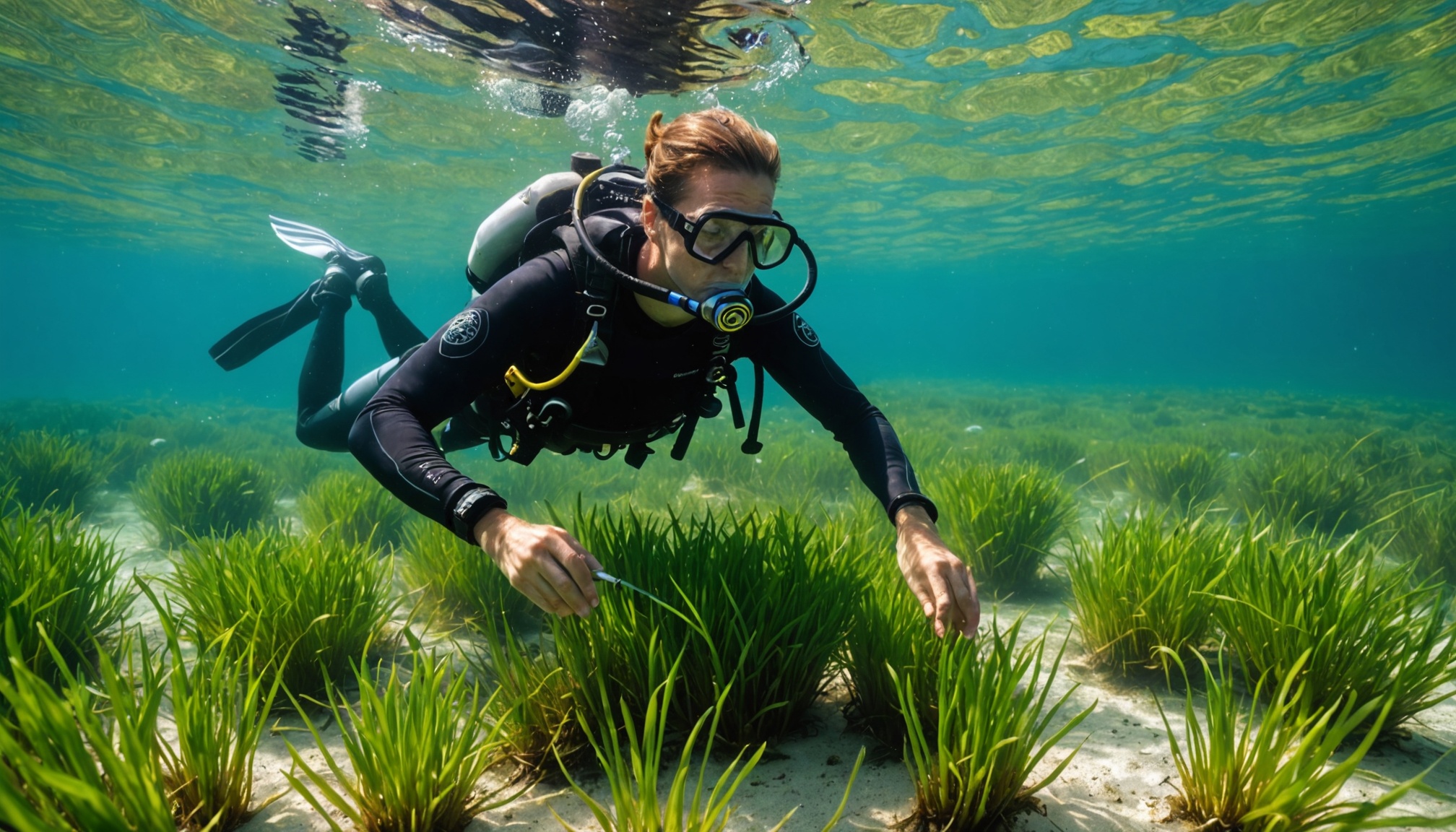
For nearly sixty years, the Berre lagoon, Europe's largest saltwater lagoon, paid the heavy price of industrialization in Provence, France. Today, an unprecedented scientific program is attempting to repair what seemed lost: the seagrass meadows that once made up the site's biological wealth. Thanks to a transplantation method monitored by drone, the first results measured in 2026 exceed researchers' expectations.
Sixty Years of Ecological Upheaval
At the beginning of the 20th century, the Berre lagoon was home to roughly 8,000 hectares of seagrass meadows, those underwater prairies of eelgrass that serve as nurseries for fish and produce part of the lagoon's oxygen. The turning point came in 1966, when EDF's (Électricité de France, the French state-owned electricity utility) hydroelectric plants began channeling water from the Durance River into the lagoon, dumping enormous volumes of silt-laden freshwater into it every year. Salinity dropped, turbidity rose, and the light needed for the seagrass's photosynthesis disappeared. The result: barely more than one hectare of eelgrass survived by the early 2000s, a collapse that closely followed the broader fragmentation of natural habitats observed along the Mediterranean coast.
The Scientific Bet on Transplantation
Since 2024, the Gipreb (the public interest group for the rehabilitation of the Berre lagoon) has been running, with support from the international scientific consortium The Seagrass Consortium, a transplantation program using eelgrass taken from healthy donor sites. A first experimental plot of just 8 square meters was tracked using drone imagery over two years: it now covers more than 750 square meters, with no degradation observed at the collection sites. In May and June 2026, a new field campaign brought together scientists from The Ocean Gardeners association alongside volunteers, in an approach reminiscent of the citizen-led participatory biodiversity surveys conducted elsewhere in France.
An Ambitious but Realistic Goal
The lagoon's current seagrass cover, estimated at around forty hectares, remains well short of the historical 8,000 hectares. Gipreb scientists are not actually aiming for a return to the pre-1960 state, but rather a target of 1,500 hectares, considered sufficient to establish an ecosystem resilient to climate change. Three species are being reintroduced in parallel: dwarf eelgrass, common eelgrass, and the seagrass species Cymodocea nodosa, chosen for their ecological complementarity. This local project is part of a broader effort, namely the national nature restoration plan that France submitted to Brussels. Another encouraging sign: since 2023, EDF's discharges into the lagoon have been more tightly regulated, limiting the freshwater and sediment inflows responsible for the original imbalance.
Why This Experiment Matters Beyond Provence
Seagrass meadows are not merely an underwater backdrop: they store carbon, stabilize seabeds, and provide breeding grounds for numerous fish and shellfish species, a role similar to the one wetlands play in regulating water quality, as illustrated by episodes of cyanobacteria blooms observed in certain French lakes and rivers. If the transplantation method proves effective in the Berre lagoon, it could serve as a model for other degraded Mediterranean lagoons, both in France and in neighboring European countries, where scientists are now seeking concrete solutions rather than mere observations. This approach falls squarely within the field of science applied to the environment, a topic that our dedicated planet section will continue to follow closely.
Frequently Asked Questions
What is a seagrass meadow and why does it matter?
A seagrass meadow is an underwater prairie formed by flowering plants like eelgrass, capable of growing beneath the water's surface. It shelters a wide diversity of fish and crustaceans, filters water, and stores carbon, making it a valuable ally against global warming.
Why did the seagrass meadows of the Berre lagoon disappear?
Starting in 1966, EDF's power plants discharged large quantities of freshwater and sediment from the Durance River into the lagoon, reducing the salinity and light levels needed for seagrass survival, which had nearly vanished by the early 2000s.
Can seagrass restoration succeed elsewhere in France?
The results achieved in the Berre lagoon, with the transplanted area multiplying a hundredfold in two years, suggest the method could be adapted to other Mediterranean lagoons affected by similar imbalances.
Sources
This article was written with the help of artificial intelligence. Editorial policy