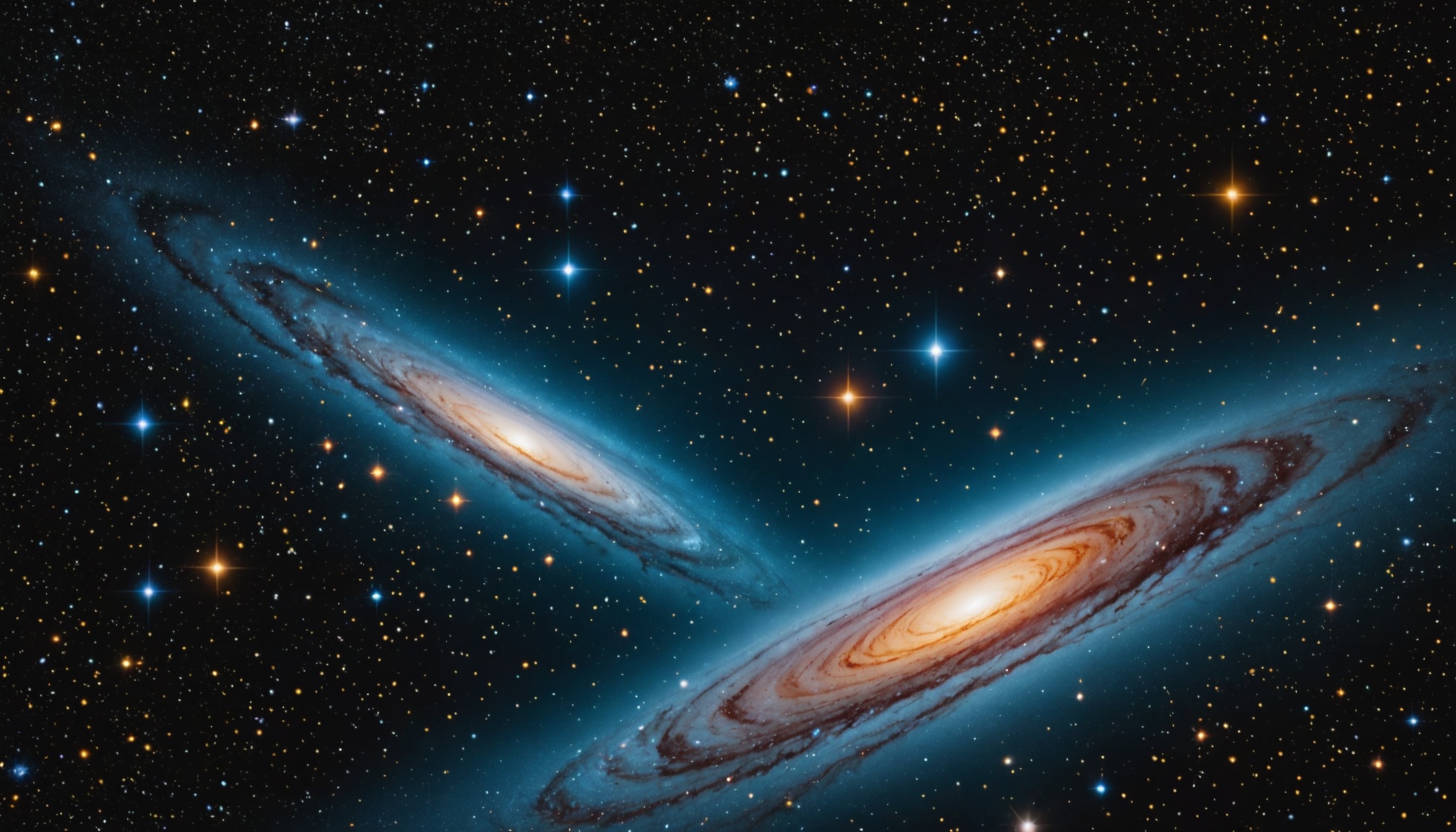
Seeing far into space is also seeing far back in time: this is the principle that has just allowed an international team of astronomers to push the limits of the observable universe even further. Thanks to the European space telescope Euclid, 31 new quasars have just been identified, including two that now hold the record for the oldest objects ever observed in the Universe.
Light 13 Billion Years Old
The two most distant quasars in this new batch, named EUCL J1729+6410 and EUCL J1253+7054, show redshifts of 7.77 and 7.69 respectively. In concrete terms, their light was emitted when the Universe, now about 13.8 billion years old, was only 670 million years old — just 5% of its current age. This record beats the previous oldest known quasar, discovered by the same scientific team in 2021, by 20 million years.
A quasar is the extremely bright core of a galaxy, powered by a supermassive black hole that devours surrounding matter at a breakneck pace, producing radiation so intense that it remains visible from billions of light-years away. Finding such objects so early in cosmic history raises a question that still has no clear answer: how could such massive black holes form and grow so quickly after the Big Bang?
An Unprecedented Discovery Rate
The result, published in the journal Astronomy & Astrophysics, is also due to the method used. Thanks to its very wide field of view, Euclid made it possible to double in just two years the number of such ancient quasars cataloged by the scientific community — a task that had previously taken more than a decade with earlier instruments. This acceleration changes the game for astrophysicists, who now have a much larger statistical sample to refine their models of early galaxy formation.
- 31 quasars newly identified by the European Space Agency's (ESA) Euclid mission.
- Age record: light emitted 670 million years after the Big Bang.
- A 5x pace: the number of known very ancient quasars has doubled in two years, compared to more than ten years previously.
These extreme objects also interest the general public beyond the circle of specialists: they remind us that technologies developed for space exploration, from image processing to the artificial intelligence used to sort through millions of light sources, later spread to other sectors. Our Tech / Net section regularly covers these technology transfers, while major scientific breakthroughs and their cultural implications can be found in our Culture section.
Why This Discovery Challenges Current Models
Current theoretical models struggle to explain how a black hole can reach several hundred million solar masses while the Universe is still an infant on the cosmic scale. Several hypotheses are being studied: the direct collapse of giant gas clouds without going through a star stage, cascading mergers of smaller black holes, or growth at a rate that exceeds classical theoretical limits. Each new quasar detected by Euclid provides an additional data point to help decide between these scenarios, as part of a mission that still has a third of the sky left to map in the coming years.
Frequently Asked Questions
What exactly is a quasar?
A quasar is the extremely bright nucleus of a distant galaxy, whose energy comes from a supermassive black hole accreting surrounding matter. This process releases radiation so powerful that it can be detected from billions of light-years away.
Why is the Euclid telescope particularly effective for this kind of discovery?
Euclid was designed by the European Space Agency with a very wide field of view, allowing it to scan vast portions of the sky in high resolution and spot rare objects, such as the oldest quasars, much faster than previous telescopes.
Do these quasars call the Big Bang theory into question?
No. They do not call the Big Bang itself into question, but they do raise questions about the models of formation and growth of supermassive black holes, whose observed speed remains difficult to explain with currently accepted theoretical mechanisms.
Sources
RTS ·
La Presse ·
Cité de l'espace
This article was written with the help of artificial intelligence. Editorial policy