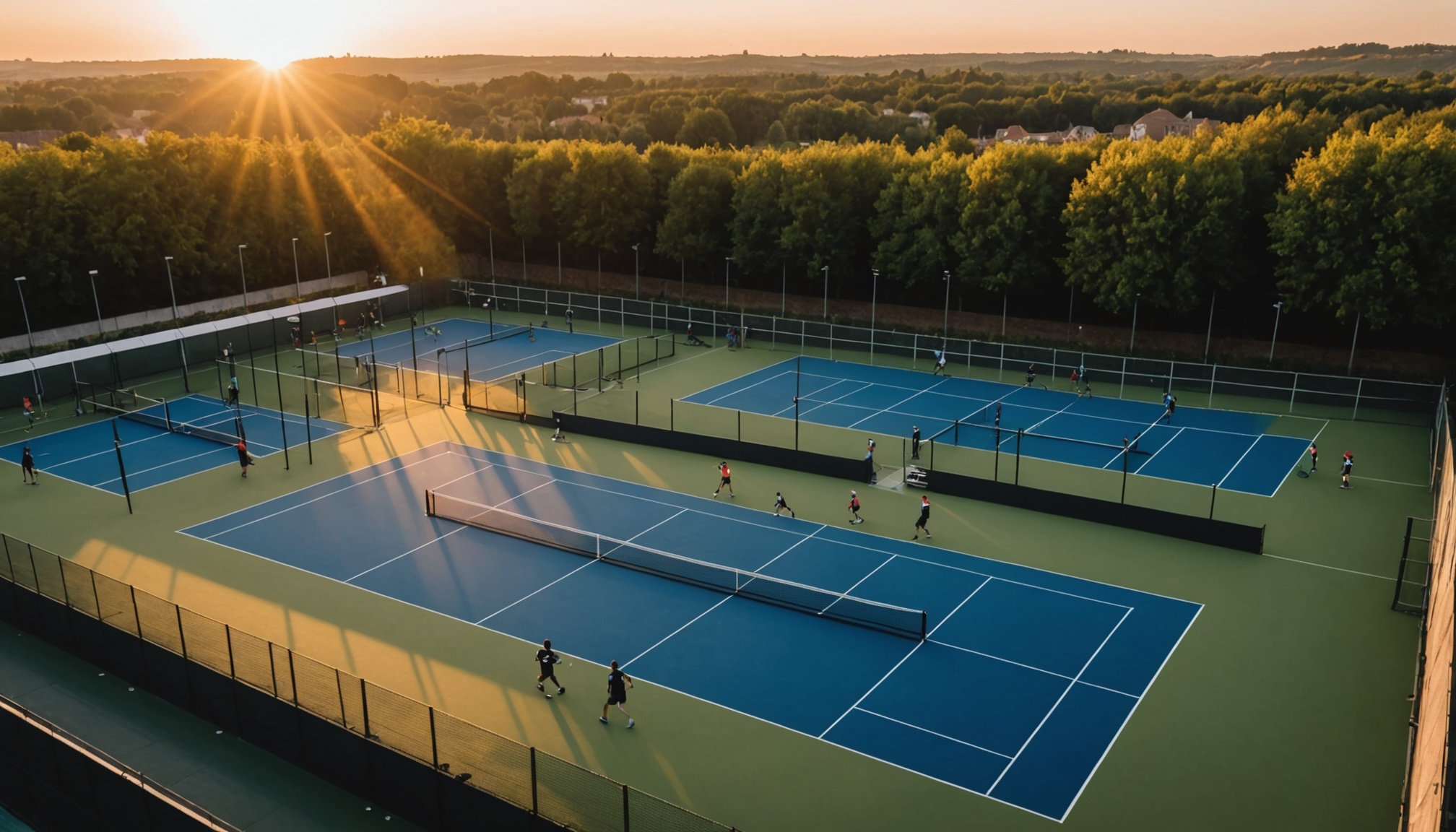
In just a few seasons, a racquet sport imported from Spain has upended the French sporting landscape. Padel is no longer just filling recreational time slots: it is reshaping the economics of an entire sector, drawing in investors, and pushing hundreds of clubs to spring up across the country. Behind the craze, official figures published by the French Tennis Federation (FFT) reveal a growth trajectory that few other disciplines can claim.
Growth That Is Breaking All Records
According to data released by the FFT in November 2025, padel now counts 272,000 licensed players in France, a 130% increase compared to 2022. The number of courts has followed the same trajectory: more than 4,000 courts are now recorded, up from barely a third of that total three years earlier—a 118% increase over the period. Around 1,027 clubs now offer the sport, compared with just a dozen in 2014. Competition itself has shifted scale, with more than 120,000 ranked players, up from fewer than 700 in 2015, and 33,310 events organized in 2025 compared with 274 in 2018.
The federation also points out that over the past eighteen months, France has become the country with the highest number of new courts built in the world—a strong signal for a sport that had almost no dedicated infrastructure a decade ago.
Clubs Springing Up Across the Country
This expansion is not limited to major cities. Mid-sized towns are also seeing dedicated complexes spring up, driven by a business model considered particularly profitable: play with four players per court guarantees a high occupancy rate and a revenue per square meter often higher than that of other racquet sports. Building a standard court, however, represents a substantial investment, generally ranging between €70,000 and €85,000, which has not dampened the appetite of private operators.
This entrepreneurial momentum is part of a broader trend toward diversifying the sports offering in France, documented in particular by a study on sports participation in France, which has also reached a record level driven by the pursuit of wellness.
A Younger, More Diverse Audience
Another distinctive feature of padel is that it appeals to a much broader audience than traditional tennis, mixing beginners, families, and casual athletes drawn in by the sociable nature of doubles play. This surge echoes trends already observed among younger players, similar to the phenomenon analyzed in our feature on Generation Z and sports, where social media plays a driving role in discovering new disciplines.
According to the Padel Observatory, more than 75% of players now frequent private commercial facilities rather than nonprofit clubs affiliated with the federation, a sign that the market has largely opened up to operators independent of the traditional federation-based system.
A Business Model That Is Attracting Investors
Padel has also caught the attention of investment funds. Groups of sports and leisure chains have raised several tens of millions of euros in recent months to fund the opening of dozens of new complexes over five years. This stands in sharp contrast to the caution seen in other sectors of professional sports, where shakeups tend to be driven by sporting logic rather than market logic—as illustrated, for example, by the surprise return of two historic clubs to Ligue 1 this season.
For industry professionals, the stated goal is now to double the number of players by the end of the decade, a bet that requires maintaining the same pace of building new infrastructure, particularly in mid-sized towns that are still underequipped.
It remains to be seen whether this double-digit growth can be sustained over time, or whether the padel market will, like other sports trends before it, go through a consolidation phase once major cities reach saturation. For now, the numbers point to continued expansion, driven by a nationwide rollout that is still far from complete.
Frequently Asked Questions
How much does it cost to build a padel court?
Installing a standard court represents an average investment of between €70,000 and €85,000, depending on the equipment chosen (roofing, lighting, surfacing) and the project's location.
Is padel reserved for experienced tennis players?
No. This is actually one of the reasons behind its success: the simplified rules and doubles format make the sport accessible from the very first sessions, with no prior technical level required, which explains its rapid adoption by a family-oriented and casual audience.
Has padel already overtaken other racquet sports in number of licensed players in France?
With 272,000 licensed players at the end of 2025, padel still trails far behind tennis, France's historic racquet sport, but its 130% growth over three years makes it the fastest-growing racquet discipline in the country.
Sources
- French Tennis Federation — official 2025 padel figures
- Sports Management School — Padel in France: growth, figures, and the future of the sport
- Midi Libre — padel news and French championships
This momentum is part of broader trends covered in our Sports section, while also intersecting with issues covered in our Business section, where investment in leisure infrastructure is becoming a topic in its own right, not to mention the consumer habits discussed in our Consumer section.
This article was written with the help of artificial intelligence. Editorial policy