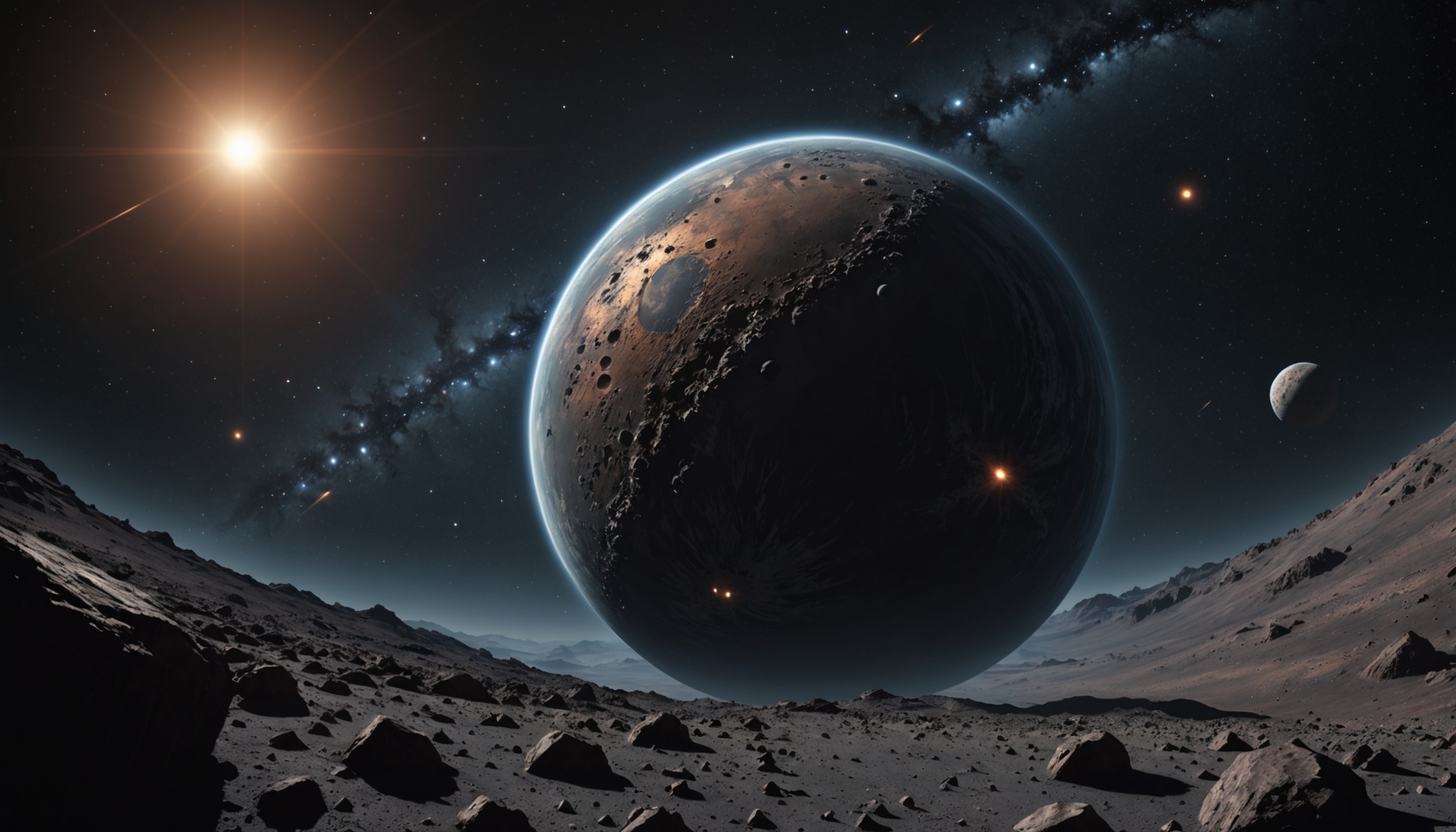
A team of American astronomers has just identified an exoplanet unlike anything known before: a “mega-Earth” 23 times more massive than our planet, yet barely 2.5 times wider. Named GJ 523b, it upends the usual models of how rocky worlds form.
A density with no known equivalent
The discovery was made by an interdisciplinary team at the Wisconsin Center for Origins Research (WiCOR), part of the University of Wisconsin-Madison, using data from NASA's TESS satellite, supplemented by ground-based observations from the WIYN Observatory in Arizona and by the James Webb Space Telescope. It was this combination of instruments that made it possible to confirm such a high mass for an object of such modest size.
According to the team's measurements, GJ 523b is about 170 million years old and has an unusually high density: the planet appears to be almost entirely rocky, with a massive core and virtually no atmosphere. Max Kroft, the doctoral student who led the characterization of the object, sums up the paradox: very dense planets are not rare in themselves, but they usually resemble worlds the size of Earth or Mercury. Here, the object is two and a half times the size of Earth while retaining that extreme density.
Two hypotheses to explain the anomaly
How can a planet this large be so dense and so devoid of atmosphere? The research team, led by assistant professor Thomas Beatty, puts forward two competing explanations. The first assumes that the planet lost its gaseous envelope following close encounters with its host star, whose radiation would have gradually stripped away its atmosphere. The second points to a collision between two planets, an impact violent enough to blast away the outer gas layers and leave only a compact rocky core.
- Mass: 23 times that of Earth
- Radius: 2.5 times that of Earth
- Estimated age: about 170 million years
- Instruments used: TESS satellite, WIYN Observatory, James Webb Telescope
- Team: Wisconsin Center for Origins Research (University of Wisconsin-Madison)
A new category of rocky planets
To describe this type of object, the researchers propose the term “mega-Earth”, a category defined by a large radius combined with a density equal to or greater than Earth's. This isn't the first time an instrument has upended our view of exoplanets: we've already reported on how the telescope that spotted the very first known exoplanet had struck again with a giant discovery, and on how James Webb helped identify a star being fed by a growing black hole. GJ 523b fits into this same pattern: each newly detected object forces astronomers to revise their planetary formation models.
The stakes go beyond mere scientific curiosity. Understanding how such dense planets can form or survive their stellar environment also sheds light on research into the origin of the ingredients for life elsewhere in the universe, a line of research that previously informed our article on the discovery of sugar in space. Future observations will need to determine which of the two hypotheses — stellar erosion or planetary collision — best explains the structure of GJ 523b.
Frequently Asked Questions
What is a “mega-Earth”?
The term describes a category of rocky planets characterized by a radius significantly larger than Earth's, but with a density equal to or greater than our own, implying a composition that is almost entirely rocky.
How was GJ 523b detected?
Through NASA's TESS satellite, which detects planets by observing periodic dips in a star's brightness, followed by complementary observations from the WIYN Observatory and the James Webb Space Telescope.
Why is this planet of particular interest to researchers?
Because its extreme density, combined with a size far greater than Earth's, doesn't fit any standard model of planetary formation, prompting astronomers to consider rare scenarios such as a collision between two planets.
Sources
- Phys.org — detailed presentation of the discovery by the University of Wisconsin-Madison team
- Ground News — summary of international media coverage of the discovery
This article was written with the help of artificial intelligence. Editorial policy