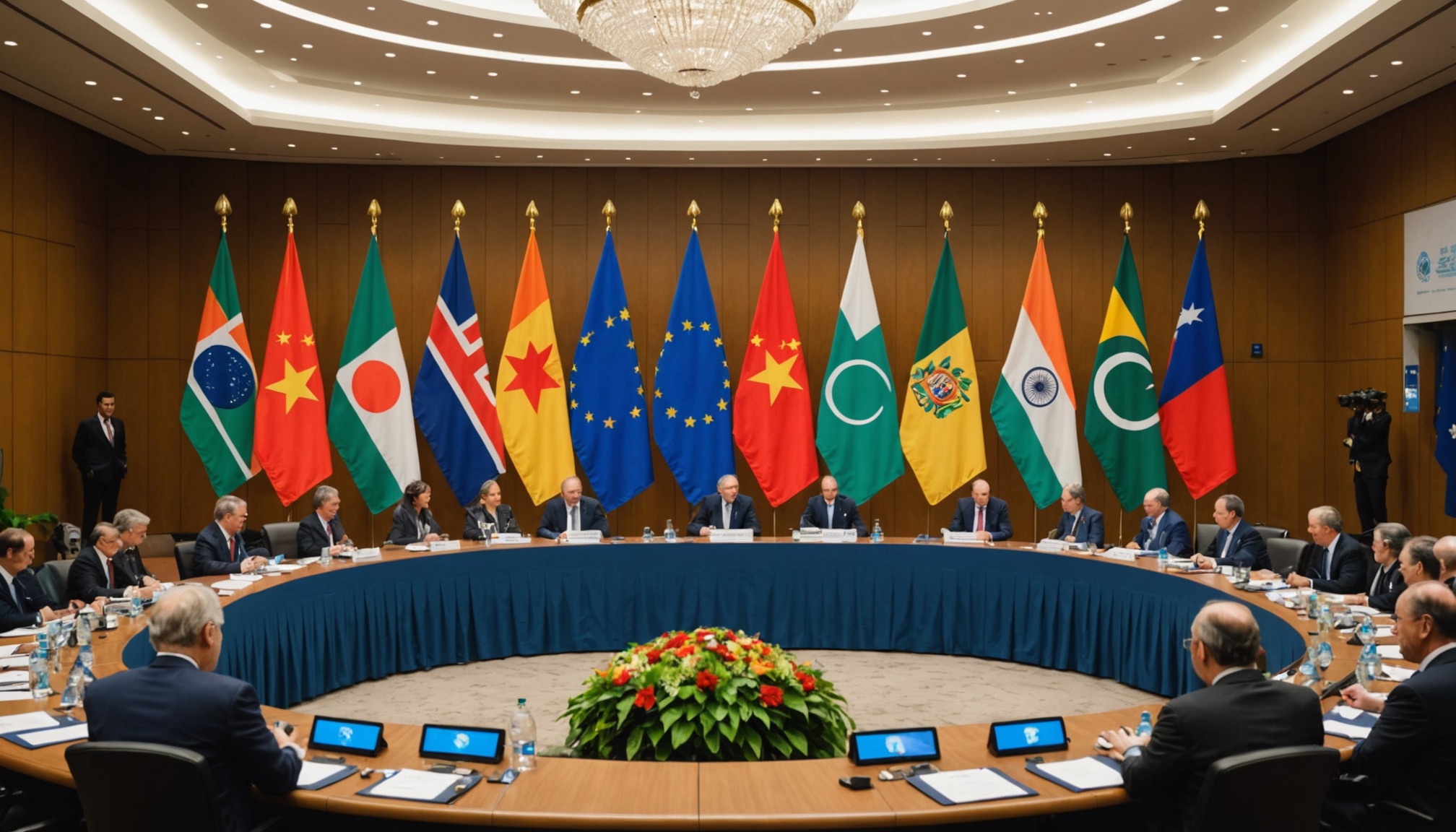
In New Delhi, BRICS leaders unanimously adopted, on September 12, 2026, a declaration that goes well beyond the usual diplomatic formulas. The BRICS summit closed with a 140-point text and more than 50 concrete mechanisms, ranging from finance to artificial intelligence. Behind the leaders' family photo lies a project of economic and institutional recomposition, driven by India, which holds the bloc's rotating presidency this year.
What the New Delhi Declaration Decided
The final text, negotiated over several months by sherpas, covers an unusually broad field: reform of international financial institutions, governance of artificial intelligence, condemnation of terrorism, and a call for “maximum restraint” over tensions in West Asia. Egypt, represented by Abdel Fattah al-Sisi, stressed the need to turn the bloc into a concrete lever for the Global South, rather than a mere platform for speeches. More than 350 BRICS meetings were organized by India across some twenty cities over the past year, a figure that gives a sense of the diplomatic investment involved.
De-Dollarization and Digital Sovereignty
On the economic front, the declaration revives the sensitive issue of de-dollarizing trade between member countries, without setting a binding timeline. India added its own mark with several concrete initiatives: a shared directory of public digital infrastructure, a training network in the healthcare sector, and a center dedicated to the bloc's industrial skills, designed to support the upgrading of smart manufacturing in member countries. This display of unity, echoing the one already staged by China and Russia at the Shanghai Cooperation Organization summit in Bishkek, reflects a deliberate strategy of tightening ties outside traditional Western frameworks.
UN Reform in the Background
The text reaffirms the bloc's support for China and Russia as permanent members of the Security Council, while advocating for a greater role for Brazil and India within the UN body. The topic comes at a fitting moment: France is beginning its rotating presidency of the Security Council for the month of September, right in the middle of the UN General Assembly's high-level week in New York. Two diplomatic calendars intersecting, though not necessarily converging on the substance of institutional reform.
The Global South, the Bloc's New Compass
Beyond the major member powers, the declaration speaks explicitly to developing countries, with commitments on climate financing and access to technology. This positioning echoes, in an entirely different geographic context, the concerns voiced by small island states at the recent Pacific Islands Forum in Palau, where climate change was identified as the top security threat. The common thread: countries that refuse to choose between major powers and are demanding financial and technological tools suited to their own needs.
Key Takeaways
- Declaration adopted unanimously on September 12, 2026, at the close of the 18th BRICS summit.
- More than 50 concrete mechanisms and initiatives, covering finance, digital policy, healthcare, and industry.
- No binding timeline set for the de-dollarization of trade.
- Renewed support for UN Security Council reform including Brazil and India.
Frequently Asked Questions
What is the New Delhi Declaration?
It is the final text unanimously adopted by BRICS heads of state at the close of their 18th summit, held in India. It brings together 140 points of consensus and more than 50 concrete initiatives covering the economy, digital policy, healthcare, and diplomacy.
Does this agreement formally establish de-dollarization?
No. The declaration revives the goal of making trade between member countries less dependent on the U.S. dollar, but without setting a timeline or binding mechanism: it is a policy direction, not an immediate operational decision.
What role did India play at this summit?
India held the BRICS rotating presidency this year. It organized more than 350 meetings across some twenty cities and championed several of its own initiatives, including a shared directory of public digital infrastructure and a center dedicated to the bloc's industrial skills.
Sources
- France 24 — coverage of the BRICS summit in New Delhi
- Forbes India — key takeaways from the New Delhi declaration
- Wikipedia — 18th BRICS summit
This article was written with the help of artificial intelligence. Editorial policy